A few months ago I was setting up a campaign and something occurred to me.
Every major timer tool I knew of stored the deadline in a cookie. Which meant the deadline lived in the subscriber's browser, not on a server somewhere.
I thought about what that meant for anyone running a 48-hour cart close to a reasonably tech-savvy list. The kind of people who know what incognito mode is for. The kind who buy things on the internet a lot.
The scarcity looked real. In practice, anyone who wanted to bypass it... probably could. Clear the cookie, open a fresh tab, start the clock over.
Anyway. That's when I started building something different.
(I also may have muttered something under my breath about the timer industry. My wife pretends not to hear when I do that.)
Picture a cart close at 11:59pm on a Thursday.
Your email goes out. The subscriber clicks the link. Before your sales page even loads, a server checks their email address. If their time is up, they land on the expired page. Full stop. No workaround. No incognito trick. No "I just got your email" appeal.
The deadline they agreed to is the one they get.
And you? You're asleep. Or watching something terrible on Netflix.
That's real scarcity. And it costs $19 a month.
Who's behind HeroTimer?
Hey, I'm Richard. (I'm the one on the left!) I've been running email campaigns for over 15 years: funnels, launches, evergreen sequences, the lot. In that time I've generated well over $2 million from a single automated funnel, and I've built campaigns for clients that have hit $116,000 in a single month.
Scarcity has been a core part of almost every campaign I've run that got serious results. And for years, the tools available either cost a fortune, capped what you could do, or created urgency that wasn't actually real.
So I built HeroTimer. A tool I'd actually want to use myself. Simple, honest, and built the way it should have been from the start.
Richard Legg Founder, HeroTimer
The problem
Most countdown timers are theatre.
The industry standard is cookie-based. The deadline gets stored in the visitor's browser. Which sounds fine, until you realise what that means:
Open the same page in incognito. Fresh cookie. Clock restarts.
Clear browser history. Clock restarts.
Use a different device or browser. New cookie. Brand new deadline.
Share the link with a friend. They get a fresh clock too.
(I tested this myself, by the way. Took about 30 seconds. Which is roughly how long it took me to decide I needed to build something different.)
Same Page. Different Browsers. Different Deadlines. (Whoops!)
The "urgency" you're creating isn't tied to anything real. It's tied to a file on their hard drive that they own, not you.
Sometimes the tools just don't play nice together and you get something like this:
[Shouts at timer software] "You had ONE job!"
What do you think that does for your credibility with your audience?
If you've ever wondered why your deadline campaigns underperform relative to what they should be doing... this is usually part of it.
And then there's the pricing problem...
Most timer tools are priced so that the better your campaigns perform, the more you pay.
Hit a subscriber threshold? Upgrade.
Running more than 5 campaigns? Upgrade.
The moment things start working (or when they add a new feature that you never asked for!) the bill goes up and you're forced to pay more or lose access.
Tool
Monthly price
Unlimited campaigns
Unlimited subscribers
Competitor 1
$49–$99/mo
✓ on top plan only
✕ capped
Competitor 2
$19–$89/mo
✕ capped until top plan
✕ always capped
Competitor 3
$97 one-time
✕ 5 campaigns max
✕ 2,000/mo max
HeroTimer
$19/mo
✓ always unlimited
✓ always unlimited
The fix
What actually makes scarcity work.
Scarcity is one of the most powerful mechanisms for influencing a person's decision. FOMO is very real. And online, one of the easiest ways to convey that scarcity is through a countdown timer.
But the thing that makes scarcity work isn't just how well the timer is designed, or what colour it is, or how it's animated.
The thing that makes people act is the honest belief that the deadline is real and cannot be cheated.
That belief only holds if the deadline is genuinely tied to them, not to a browser they can close.
With HeroTimer the deadline is tied to each subscribers email address. When they click your links, HeroTimer checks their individual deadline before your sales page even loads. If it's expired they're redirected and never see your sales page at all. There's no cookie to edit. No browser to refresh. Nothing to clear. Expired means expired.
That's the architecture HeroTimer is built on.
Honest scarcity. Server-side. Tied to email. Not the browser.
What you get
Everything you actually need. Nothing you don't.
Evergreen Strict Timers: Exact Personal Deadlines
The clock starts the moment someone opts in and counts down to the second. Set it for 30 minutes, 4 hours, or 72 hours. Perfect for upsell pages and time-sensitive offers where every minute counts.
(Someone who opts in at 2am gets exactly the same window as someone who opts in at 2pm. No exceptions.)
Who sets a real deadline to expire at 2:37pm on a Tuesday? Rounded timers let you set an expiry at a specific time of day (say, 11:59pm three days after optin). Every subscriber gets a personal deadline that looks and feels like a real launch close.
(Nobody has ever said "I trust this deadline because it expires at 4:17am." Nobody.)
Fixed Timers: One Deadline for Everyone
For launches, webinar replays, and flash sales where every subscriber sees the same cart close. Set a date and time once. When Friday at midnight is the deadline, it's the deadline for everyone.
Embeddable Web Widget: Inline and Sticky Bars
Paste one snippet of code. Choose whether the timer appears inline, as a sticky bar at the top, or at the bottom. The sticky bar can be minimised to a small clock icon. Subscribers who find it annoying can tuck it away.
Animated Email Timers
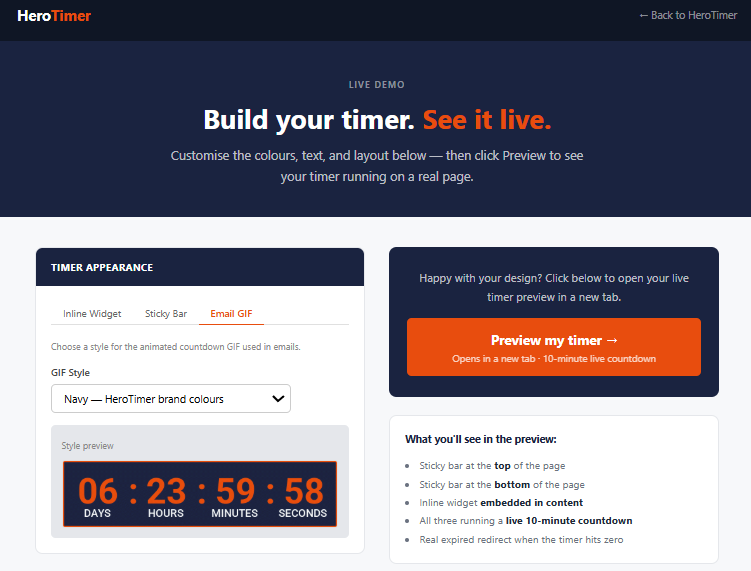
When the subscriber opens the email, the GIF animates a live countdown. The email timer always matches the clock on the page. Works with ActiveCampaign, Kit, Mailchimp, AWeber, GetResponse, Drip and any platform with HTML emails.
Server-side expiry enforcement
When a subscriber clicks your email link, the server checks their deadline before a single byte of your sales page loads. Expired subscribers get redirected immediately. The page never loads. This isn't a JavaScript check that fires after. It happens first.
Three independent appearance profiles
Separate colour and style controls for the inline widget, the sticky bar, and the email GIF. The GIF defaults to a white background so it works out of the box in any email client.
Text and layout customisation
Add a headline above the timer. Add a sub-line below. Choose whether text sits to the left or right of the timer, or stacks above and below. Show or hide the DAYS / HOURS / MINUTES / SECONDS labels. Change the separator style.
Preview mode
A Preview button on every campaign generates a signed 10-minute test token. Click it, and a new tab opens directly on your sales page with the timer running. No dummy records. Your real page with a real working timer.
Your own subdomain
Every account gets its own yourbrand.herotimer.com subdomain. Your subscribers' emails contain your subdomain, not a generic third-party address. More professional. Better for deliverability.
Smart Deadline Display
A timer showing "18 days, 4 hours, 22 minutes" is the opposite of urgent. It looks like you added a timer just for the sake of it. Smart Deadline Display shows the actual date when the deadline is far away ("e.g. Sunday 12 July"), then switches to a live countdown when it matters most.
Works With Any Page Builder
Two lines of code. Paste them anywhere. Elementor, Divi, ClickFunnels, GoHighLevel, WordPress, plain HTML. No plugin to install. No API key. No developer needed. If the page lets you paste HTML, HeroTimer works on it.
Always unlimited
Unlimited campaigns. Unlimited subscribers. No caps. No usage tiers. No upgrade required when you start getting results.
Try it yourself
See it before you buy it.
The demo is live. Build a timer, try the styles, see the sticky bar and inline widget in action. No account. No email address. Nothing to sign up for.
What real scarcity actually does to conversion rates.
Here's what I know from running email campaigns for over 15 years. The single biggest conversion difference in deadline campaigns isn't the timer design, the email copy, or even the offer. It's whether the deadline is honest.
I've run the same offer twice: once with vague "closing soon" messaging, once with a hard deadline and real scarcity. The version with real scarcity converted at 170% more. Same offer. Same list. Same price.
170%
more conversions with a hard deadline vs "closing soon"
$149
per email address from a single campaign (826 registrations)
$123k
total from one offer, one list, one campaign
[PLACEHOLDER: Add 2–3 customer testimonials here. Specific results preferred over generic praise — e.g. "Timer on my upsell page went from 8% to 14% conversion in the first week."]
Five reasons
Why real scarcity isn't optional.
1
Once the deadline isn't real, the trust is gone. And so are future sales.
The moment a subscriber realises they can reset your timer, they don't just ignore that one offer. They file you away as someone whose urgency can't be trusted. Every future campaign you run lands in that mental category. The "closing soon" email. The "last chance" subject line. They've already decided it doesn't mean anything.
That's not a missed sale. That's a permanently damaged relationship with someone who was already on your list.
2
A real missed deadline trains your list to take you seriously next time.
When a subscriber clicks your link and genuinely hits the expired page, something useful happens. They learn you mean it. They didn't buy in time, the offer is gone, and you didn't fold. That's not a lost sale. That's an investment in every campaign you'll ever run to that person in the future.
The subscriber who misses one real deadline is often the fastest buyer next time around.
3
Your list already knows how to test whether your timers are real.
Your subscribers have been buying online for years. Many of them have already opened your page in incognito just to see what happens. If the clock reset, they noticed. They might not have said anything. They just quietly updated their mental model of how seriously to take your deadlines.
Sophisticated buyers test everything. Cookie-based timers fail that test in about thirty seconds.
4
One fake timer undermines everything else you're doing to build trust.
You write honest copy. You don't inflate your results. You don't use fake testimonials. You do everything right... and then you run a countdown that resets when someone clears their cookies.
Trust isn't built in one place and kept separately from the rest. It's a single thing. One weak link puts the whole structure under pressure. The timer is visible on your sales page. It's exactly the kind of detail a sceptical buyer notices.
5
Fake deadlines kill engagement. And low engagement kills deliverability.
When subscribers stop believing your urgency, they stop clicking. When they stop clicking, your engagement rates drop. When your engagement rates drop, inbox algorithms notice. Gmail, Outlook, Apple Mail all use engagement signals to decide whether your next email lands in the inbox or the promotions tab.
Fake scarcity doesn't just underperform on the campaign you're running. It quietly moves future emails further from the inbox, further from the eyes of the people who would have bought.
Common questions
A few things you're probably wondering.
"I already use a timer tool. Why would I switch?"
If cookie-based scarcity is working fine, stay where you are.
But if your deadline campaigns consistently underperform relative to what they should be doing, the timer is usually part of the reason. A subscriber who's ever reset your clock by opening incognito didn't just beat your deadline once. They stopped believing your deadlines are real. And that belief doesn't come back.
That's what fake urgency actually costs. Not one sale. Every sale after it.
Migration takes an afternoon. Your list starts believing your deadlines again from the first campaign.
"Is $19/month too cheap to be any good?"
HeroTimer is priced low not because it cuts corners, but because it deliberately doesn't build features for edge cases that 95% of users will never need.
The big timer tools charge $99/month because they built for every possible scenario: abandoned cart recovery, membership portals, social proof integrations, API access. Most customers use about 10% of it.
HeroTimer does the 10% that matters: evergreen timers, launch timers, email GIFs, sticky bars. And it executes them well.
Some tools are now bundling in AI assistants and charging accordingly. Nobody buying a countdown timer asked for an AI assistant. But everybody buying a countdown timer is now paying for one.
(I have nothing against AI assistants. I use one constantly. I just don't need to spend an extra $500+ per year just to have one that helps me count down to midnight.)
No complexity tax. Just one extra sale on a low-ticket offer covers the monthly cost.
"What if I have a lot of subscribers?"
Unlimited. Every plan, every month, forever. There's no tier where the price goes up because you're doing well.
"Does it work with my email platform?"
If your platform lets you set a redirect URL after someone opts in (and virtually all of them do), it works. ActiveCampaign, Kit, Mailchimp, AWeber, GetResponse, Drip, all confirmed compatible. The email GIF works with any platform that supports HTML emails.
"I'm not technical. Will I be able to set this up?"
Creating a campaign is a form. Add your redirect URLs, choose your timer type, set your duration, customise the appearance, and copy the embed codes into your page. That's it. If you can fill in a form and paste a snippet of code, you can run HeroTimer.
Proof, not promises
See exactly what real deadlines did to these two campaigns.
You don't have to take my word for it that real scarcity outperforms fake scarcity. These two case studies document exactly what happened when real, personal deadlines replaced vague "closing soon" language in actual campaigns. Specific numbers from real funnels. No theory.
Bonus Case Study #1$116,117 in a single month
The $116,117/Month Automated Sales Funnel
This case study documents a fully automated, evergreen funnel that generated 418 new customers and over $116,000 in a single month. The funnel ran without live launches, without phone sales, and without a team.
Urgency and scarcity sit at the centre of it. Before the evergreen deadline system was added, the follow-up sequence used the same emails and sent the same traffic to the same offer. The only difference was swapping vague "closing soon" language for a real, personal deadline tied to each subscriber.
Conversions doubled. Read that again. The same funnel, the same emails, the same offer. Doubled, just from making the deadline real.
The case study walks through every part of the funnel: lead generation, the front-end sale, upsells, the high-ticket automated webinar sequence, and the back-end offer. You'll see exactly where each deadline was set, how the scarcity was structured, and how the email frequency was ramped up as each subscriber's deadline approached.
Included free with every HeroTimer account.
Bonus Case Study #2$149.55 per email address
The $149 Per Email Address Campaign
Most email marketers are happy with $1-2 per subscriber. This campaign generated $149.55 per registration from a single promotional run to one partner's audience.
After the live webinar, a three-day replay sequence (with a real, hard deadline) added another $48,000.
Scarcity ran throughout. A hard deadline on a $500 follow-up offer to non-buyers increased conversions by 170% compared to telling people it was "closing soon." Same offer. Same list. Same price. The only variable was a real deadline instead of a vague one.
The case study breaks down the full sequence: the pre-sell, the live webinar structure, the replay strategy, the non-buyer follow-up, and how the evergreen version of this same campaign went on to generate over $2 million in total revenue from a single automated funnel.
Included free with every HeroTimer account.
What you get
Everything included. Always unlimited.
Evergreen timers (strict and rounded): personal deadline per subscriber, server-side, tied to email. Cannot be cleared or reset.
Fixed timers: one deadline for every subscriber. Real launch deadlines.
Embeddable web widget: inline, sticky-top, or sticky-bottom. Three independent appearance profiles.
Animated email GIF: live countdown in any email client. The email timer always matches the clock on the page.
Server-side expiry enforcement: expired subscribers redirected before your page loads.
Smart Deadline Display: shows the actual close date when the deadline is far away, switches to a live countdown when it matters most.
Works with any page builder: Elementor, Divi, ClickFunnels, GoHighLevel, WordPress, plain HTML. Two lines of code, paste anywhere.
Preview mode: signed 10-minute test token on every campaign. Your real page. No database entries.
Your own subdomain:yourbrand.herotimer.com. Your brand in the link.
Unlimited campaigns. Unlimited subscribers. No caps. Always.
Bonus Case Study #1: The $116,117/Month Automated Sales Funnel. A full breakdown of a real evergreen funnel where adding a hard, personal deadline to the follow-up sequence doubled conversions overnight. You'll see exactly how the scarcity was structured, where the timer was used, and how the same principle was applied at every stage of the funnel from front-end sale to high-ticket close.
Bonus Case Study #2: The $149 Per Email Address Campaign. A documented campaign that generated $149.55 per registration, including a three-day replay sequence (with a real deadline) that added $48,000 after the live webinar had already closed. The same funnel, automated, went on to generate over $2 million. You'll see precisely how urgency was used at each stage to move people from "maybe later" to "I need this now."
✕You're running cold traffic straight to a landing page with no email follow-up sequence. HeroTimer is built for email-based deadline campaigns. It needs a subscriber record to work properly.
✕You're happy with your current timer tool and your campaigns are converting the way you want. Genuinely. If it's working, don't fix it.
✕You're looking for a tool that builds landing pages, manages your email list, or runs your webinars. HeroTimer does one thing: real, ungameable deadlines. Brilliantly.
The 30-Day More Sales Guarantee
Use HeroTimer in a campaign. If you don't see a genuine improvement in conversions from deadlines your subscribers can't game, email me within 30 days and I'll refund every penny. No forms. No questions. No waiting.
I've been running deadline campaigns for 15 years. I'm not worried about this guarantee.
Founders Rate
One more thing before you decide.
About 20 years ago I ran my first ever marketing campaign. It cost me $50, went into a local newspaper, and made me realise I'd found the thing I was going to do for the rest of my life.
(TWENTY years. Yes, I know. I believe the technical term is "funnel fossil.")
I mention this not to be nostalgic, but because it means I've seen a lot of "act fast before the price goes up" copy in my time, and have seen enough to know that a lot of it is complete B.S.
So when I tell you that $19/month is the Founders Rate and the price will increase at some point... I understand if your first instinct is to nod politely and move on.
But here's the thing. I've spent those 20 years building a reputation for being honest with people. It's genuinely the one marketing asset I'd never burn for a cheap conversion. The price will go up. Everyone inside before it does stays at $19/month permanently, for the full product, with no limits.
Unlimited campaigns. Unlimited subscribers. Unlimited timers. For as long as you want.
The people who join after the price increases will still get everything you get. They just pay more for it.
Early adopters take a chance. The Founders Rate is how I say thank you for that. That's the whole deal.
Founding member pricing. Grandfathered permanently.
Here's the honest version of why this exists.
I needed a timer tool I could trust. Not one that creates the appearance of scarcity. A tool where the deadline is real, tied to the subscriber, and impossible to game.
The tools that did this were either expensive, capped, or both.
So I built HeroTimer.
(My physics degree turned out to be less useful for this than expected. The database logic, on the other hand, worked out fine.)
Solopreneurs, coaches, course creators, and info product sellers who run email campaigns with time-limited offers. If you send emails with deadline links and embed timers on sales pages, HeroTimer is for you.
Who is it NOT for?
Anyone running cold traffic straight to a page with no email follow-up. HeroTimer is built for email-based deadline campaigns and needs a subscriber record to work. It also won't replace your page builder, email platform, or webinar tool. It does one thing very well. If you need everything under one roof, the enterprise timer tools are out there at five times the price.
Does it work with my page builder?
Yes. The timer is a standard JavaScript embed. It works with any HTML page: ClickFunnels, Leadpages, Kartra, WordPress, custom HTML, anything.
How does the email GIF work exactly?
You add one image tag to your email template with your campaign ID and the subscriber's email merge tag. When the email is opened, the image is generated in real time and starts counting down. After 60 seconds it freezes on that frame. The timer on the landing page stays accurate. The GIF is just a visual preview.
What happens when the deadline expires?
Three things: (1) the web widget redirects the subscriber to your expired URL, (2) the sticky bar shows the timer at zero, (3) if they click your email link, they're redirected server-side before the page loads. Expired is fully expired across every touchpoint.
Can subscribers reset their timer?
No. The deadline is stored in the database against their email address. There is no cookie to clear, no browser trick that changes it. The only way to reset it is if you delete their record in the admin, which you control.
What's the refund policy?
30 days. If you don't see a genuine improvement in conversions, email me and I'll refund every penny. No forms, no questions, no waiting.
How do I set up a timer?
Choose your timer type, set the duration, add your redirect URLs, and customise the appearance using the visual editor: colours, text, layout, all of it. No coding. No guesswork. See exactly what it looks like as you make changes. Try it out for yourself with the live demo and see exactly how easy it is to create and customise.
I'm already using another timer tool. How hard is it to switch?
About an afternoon. Create your campaigns in HeroTimer, swap out the embed codes on your pages, and update the redirect URLs in your email sequences. There's nothing to export or import. HeroTimer starts building fresh subscriber records from the first optin after you switch. Most people set it up alongside their existing tool, test it on one campaign, and migrate the rest once they've seen it work.
How do I get started?
Click the orange button below. Create your account, and you can have your first timer set up and running on a live page in the next 10 minutes.
I'm Richard Legg. I've been running online businesses and email campaigns for over 15 years. In that time I've generated millions of dollars in sales for my own products and for clients, almost all of it through email.
HeroTimer exists because I needed it myself. I wanted a timer I could trust. One where the deadline was actually real, not just a convincing-looking clock that reset whenever someone opened an incognito tab.
I built it. I use it in my own campaigns. And I'm making it available at $19/month because the alternative is paying $99/month for the same thing with a load of features you'll never open.
I live in the UK with my wife, two boys, and a Golden Retriever named Tango who has never once respected a deadline in her life.
Pricing
One price. Everything included.
No tiers. No caps. No features locked behind an upgrade. One flat price gets you everything, forever.